Higher Education -
Spencer C. Pratt ( PDF) PDF)
Budget SummaryThe Higher Education Appropriations Subcommittee reviews and discusses budgetary issues as they relate to public, post-secondary education in the state. These budget issues often provide the framework for policy decisions to improve the delivery of higher education to the citizens of the state.
The Utah System of Higher Education includes the eight public, credit-granting colleges and universities and the Utah College of Applied Technology, a noncredit granting institution that provides career and technical education at eight locations statewide. In addition to core academic programs, the USHE promotes research, economic, cultural, and social programs for the citizens of Utah. The subcommittee is concentrating its efforts towards increasing student participation, retention, and completion. In addition, the subcommittee is trying to emphasize performance and outcomes through performance-based funding, which rewards those institutions that show improvement in certain, specific areas. Operating and Capital Budget* (in millions) 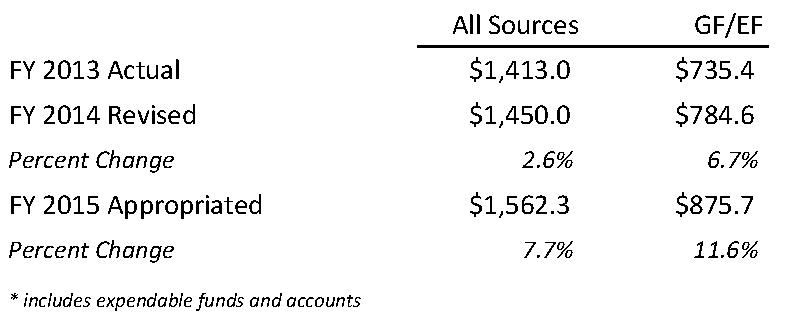
Major Funding Initiatives
- USHE Mission Based Funding - Equity - $50 million ongoing. This funding provides state resources to those institutions that currently rely more heavily on tuition than state tax funds. Utah Valley University and Salt Lake Community College will receive the major portion of this funding, which will help them approach a minimum funding per FTE student level.
- USHE Mission Based Funding - Distinctive Mission - $7 million ongoing. This funding provides resources to each USHE institution given the institution's specific mission.
- USHE Performance Based Funding - $1.5 million one-time. This funding will continue last year's appropriation which rewards institutions that demonstrate improvements in specific areas that will ultimately result in more graduates.
- College Readiness Initiative - $1 million ongoing. A new initiative to help students determine their own route relative to post-secondary education.
- Utah State University Graduate Programs - $500,000 ongoing and $500,000 one-time, to continue funding programs where there is capacity to handle additional post-graduate students.
- Utah State University School of Veterinary Medicine - $1.5 million ongoing, which is the second funding phase of the program started three years ago. The beginning class of students in the program will finish their third year (of four) this Spring.
- UCAT Campus Capacity - $3.0 million ongoing. UCAT is committed to the 66% goal of Utahns holding a degree or certificate by the year 2020. Increases in campus program capacity will enhance certificate growth at each of the eight UCAT campuses.
- UCAT Campus Equity - $3.0 million ongoing. UCAT campuses are each assigned geographic areas within the state known as service regions. UCAT has developed a request to ensure that each region is adequately served. UCAT has taken population criteria and current service levels into consideration to calculate equity amounts to help campuses serve their regions.
- UCAT Custom Fit - $500,000 ongoing. This funding provides more employers access to training as employee development needs continue to evolve.
Bills with Fiscal Impact- H.B. 155, Utah Communication Agency Network: Replaces the Poison Control Center's dedicated credits from the telephone surcharge with General Fund in the amount of $2.1 million.
- S.B. 16, Veterans Tuition Gap Program: Provides $125,000 ongoing and $75,000 one-time in tuition assistance to veterans who have exhausted their other educational benefits.
- S.B. 38, Snow College Concurrent Education Program: Will provide $1.3 million to Snow College to implement a concurrent enrollment program for rural school districts.
Significant Intent Language and Legislative ActionsThe Higher Education Appropriations Subcommittee wants to have additional, specific performance data in order to determine institutions' effectiveness. For USHE institutions, approved intent language included the following: - The Legislature intends that the institution report on the following performance measures: (1) graduation rates (100 percent, 150 percent, and 200 percent) by cohort, with comparisons to national averages; (2) transfer and retention rates, by cohort; (3) job placement rates following graduation, by classification of instructional program (CIP) where feasible; (4) cost per degree as defined by CIP, with comparisons to national averages, if available; (5) percentage of students enrolling in, and successfully completing, developmental mathematics course who immediately or concurrently enroll in college level math (1030 or higher); and (6) the amount of grant money applied for and received and the number of research/outreach initiatives funded by non-state-funded grants [specific to the University of Utah and Utah State University only]. The Legislature intends that this information be available to the Higher Education Appropriations Subcommittee by January 15, 2015.
For the Utah College of Applied Technology, the intent language is as follows: - The Legislature intends that the Utah College of Applied Technology provide summary year-end performance data for certificate-seeking, occupational upgrade, other post-secondary, and secondary students detailing the number and percentage of: (1) completers (graduate and non-graduate/early-hire completers, where applicable); (2) non-completers, and (3) those who are still enrolled at the end of the fiscal year. The Legislature further intends that the Utah College of Applied Technology provide summary data detailing average cost per membership hour, average cost per certificate awarded, and average cost per occupational upgrade awarded.
|
March 2014 Content
( PDF)
Business, Economic Development, and Labor - Andrea WilkoDuring the 2014 General Session, the subcommittee continued to focus on issues that w...
Executive Appropriations Committee - Steven M. AllredIn addition to being the "hub" committee to which all the subcommittees of the Joint ...
Executive Offices and Criminal Justice - Gary R. SyphusAppropriations for the Executive Offices and Criminal Justice Appropriations Subcommi...
Higher Education - Spencer C. PrattThe Higher Education Appropriations Subcommittee reviews and discusses budgetary issu...
Infrastructure and General Government - Mark BleazardThe Infrastructure and General Government Appropriations Subcommittee oversees the Ca...
Natural Resources, Agriculture, and Environmental Quality - Ivan D. DjambovThe subcommittee oversees the budgets for the Department of
Natural Resources, Depart...
Public Education - Ben LeishmanAppropriations made as part of the public education budget provide the majority of th...
Retirement and Independent Entities - Brian D. FayThe Retirement and Independent Entities Appropriations Subcommittee oversees the oper...
Social Services - Stephen C. JardineThe Social Services Appropriations Subcommittee oversees the departments of Health, H...
Statewide Overview - Jonathan BallStatewide OverviewUtah's budget for fiscal year 2015 is $13.5 billion (+4.7% vs FY 14 original) fro...
|